Compliant.
Unified.
Connected.
The definitive solution for CHEDS data submission, ensuring continuous compliance and seamless integration with MOHESR Master API.
Learn More Get Started
The definitive solution for CHEDS data submission, ensuring continuous compliance and seamless integration with MOHESR Master API.
Learn More Get Started
Universities face critical challenges in CHEDS data management

Recent ministry updates now require all universities to submit CHEDS data through the Master API on a regular schedule.

Institutions must maintain strict compliance, as data-governance audits may occur at any time.

Multiple systems holding different pieces of data. No version control.

Ministry requires all data to be submitted through Master API. Master API is constantly being updated. Frequent structural changes in CHEDS data formats increase workload on IT and QA teams.
Universities desperately need a definitive solution to CHEDS data fragmentation, ensure continuous compliance, and adapt to evolving ministry requirements.
A unified, centralized, on-premises repository purpose-built for compliant CHEDS data submission

A unified, centralized, on-premises repository purpose-built for compliant CHEDS data submission.
Upload structured datasets (CSV/XLS) — DataSync instantly validates them against CHEDS rules, ensuring compliance from the start.
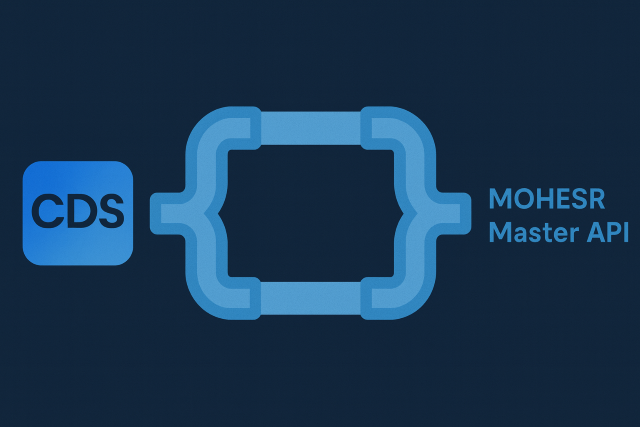
Automatic record-update handling to Master API ensures changes remain connected, synchronized, and versioned for a unified data source.

Fix individual errors on the spot — ensuring compliant data without full re-uploads.
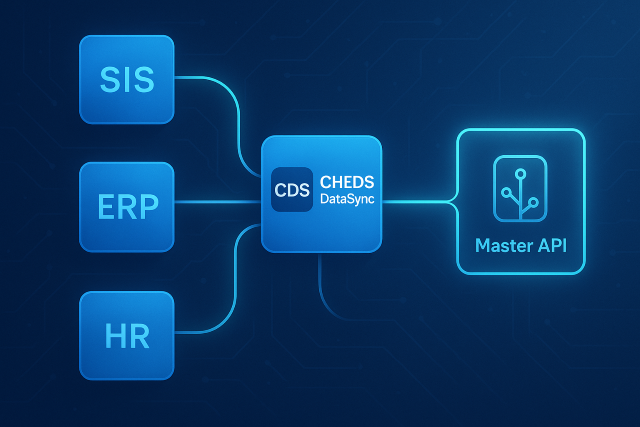
Integration with university SIS, ERP, HR systems ensures unified and continuous data exchange.

Role-Based Access Control (RBAC): permission-based visibility ensures compliant data access, with each department only accessing its own data.
Comprehensive audit trail provides full accountability for every dataset submitted to the Master API, ensuring full compliance. Always aligned with the latest CHEDS governance and data-structure updates. Our compliant, unified, and connected solution lets you focus on your data, not on decoding compliance.
From upload to submission — DataSync gives you complete visibility, accuracy, and control.
Upload structured CSV/XLS files into DataSync.
Validate instantly — see issues line-by-line.
Fix on the fly — correct errors directly within DataSync.
Handle updates automatically. Ensure no duplicate records are submitted.
Connect directly to your internal systems for automated pulls.
Submit securely to the CHEDS Master API.
Built for UAE Standards
DataSync is designed to meet UAE Personal Data Protection Law (PDPL) requirements, ensuring that sensitive student and staff information remains secure and compliant.
Multi-layered protection safeguards your institutional data at every stage:
Peace of mind: Your data never leaves your infrastructure without explicit authorization and full audit visibility.
Yes. DataSync can integrate directly with your internal systems (ERP, SIS, HRMS, etc.) as long as your data follows the same structure and format required by MOHESR templates. If your internal systems are not yet aligned with those formats, you can start with manual uploads while your technical team prepares the integration. This ensures your institution remains compliant without delays.
Even with internal systems, MOHESR requires standardized, validated, and timely submissions through approved channels. DataSync serves as the compliance bridge — transforming, validating, and syncing institutional data securely to the MOHESR Master API in line with the Data Governance Handbook.
Yes. DataSync is designed around PDPL and MOHESR privacy principles (Sections 6 & 7). It implements role-based access control (RBAC), encryption in transit and at rest, and comprehensive audit logging, helping institutions demonstrate full compliance during MOHESR reviews.
Yes. Whether uploaded via integration or manually, compliance is determined by data accuracy, timeliness, and classification, not the method. DataSync ensures all uploads meet MOHESR standards for validation, approval, and security.
All PII is encrypted and transmitted securely via API channels, in line with Section 6.2 of the MOHESR Handbook. Only authorized users can view or correct records, and every action is logged to meet accountability and breach response requirements.
Section 11 of the Handbook defines update frequencies as mandatory. Missing these can affect your compliance status. DataSync includes automated reminders, dashboards, and error alerts to help institutions stay compliant and avoid penalties.
DataSync validates each record against MOHESR schemas to ensure accuracy, completeness, and consistency per Section 5 (Data Quality Dimensions). Errors can be reviewed and corrected easily through the Error Correction screen before submission.
Yes. DataSync follows ISO/IEC 27001 and 27701 standards and provides detailed audit trails, ensuring transparency, accountability, and readiness for MOHESR audits.
Ready to ensure compliance? Contact us today.